Showing posts with label runny nose. Show all posts

Sunday, December 3, 2017

New Allergy Guidelines for People Over 12 Years Old

If you or your kids suffer from allergies, I'm sure you want to know how to best manage them. In addition to limiting exposure, medications can be a big benefit. 

allergy, antihistamine, nasal steroid, nasal spray, corticosteroid, asthma


The American Academy of Allergy, Asthma, and Immunology and the American College of Allergy, Asthma, and Immunology (AAAAI and ACAAI) have published new guidelines in the Annals of Internal Medicine for the initial medical treatment of seasonal allergies in people 12 years and older.

The recommendations essentially state:
  • Use steroid nasal sprays first without an oral or nasal antihistamine. Many intranasal steroids are available over the counter without a prescription. A great list is included on the AAAAI website. (Be careful to not to confuse them with the nasal antihistamines, which are in the same chart but identified in the column titled "Class".) 
  • In those over 15 years, the nasal steroid is preferred over a leukotriene receptor antagonist (ie Singulair or montelukast). For those with asthma, the leukotriene receptor antagonist might offer an additional benefit for asthma, but it is not the preferred treatment in either allergies or asthma. (I think the age change is simply due to the ages studied but it was not specified.)
  • In moderate to severe allergic conditions, a combination of nasal steroid and nasal antihistamine can be considered. 
These recommendations are based on a review of many studies to show what treatments worked and what didn't. They also took into consideration the fact that oral antihistamines can cause sedation and the nasal antihistamines do not. In general the nasal steroids worked better than other treatments. They did note that for people who do not tolerate nasal sprays, alternates would be oral antihistamines or leukotriene receptor agonists.


Sunday, August 23, 2015

"It's just my allergies." Is it?

I've seen many parents over the years who complain that their allergies are really giving them (or their children) problems. They insist it's just allergies though when I suggest that maybe they're sick. Why do they think it's allergies and I think they might have a virus-- and why does it matter?


Allergies can cause runny nose, watery eyes, sneezing, headache, ear pain or popping, cough and sore throat from postnasal drip.

Viruses can cause the same symptoms, so it's very confusing which is the culprit sometimes. If there's a fever or body aches, it is more likely from illness, not allergy, but not everyone with an infection gets a fever, especially older kids and adults. Not everyone with fever needs an antibiotic. Many people think clear mucus is certainly allergies and discolored mucus is bacteria, but that isn't always the case. The color of mucus depends on how long the mucus is in the nose and sinuses and how much your immune system is fighting back. It is common after a few days for the mucus to be yellow, even if it's not a bacterial sinus infection.

I've seen people treated by allergists for years for allergies only to find out with allergy testing that there aren't any allergies. It's hard for even the experts to know sometimes!

Why do I suspect these parents (or kids) have a virus and not allergies?


  • Time of year. Allergies can occur year round, but there are typical times that various pollen counts go up. If it's not a high pollen count time (or other possible exposure to allergen such as a new cat), I wouldn't expect a sudden increase in allergy symptoms. 
  • Their child is sick. If a child is sick with fever, runny nose, cough, ear infection, or other similar symptoms, it is common for them to share with the parent (and siblings). Parents and older kids often get colds without fever, so no fever doesn't rule out an infection.
  • The community is sick. When we're seeing a lot of upper respiratory tract infections in the community, it is at least something to consider.


Why does this all matter anyway?


  • Not all treatments for allergies work well for viruses. Treating the symptoms with the proper treatment is important (although there really isn't a wonder treatment for most upper respiratory viruses). When people think they become tolerant to their allergy medicine because it doesn't work for their symptoms, they are likely to not use it when appropriate for allergies. They might switch to a more expensive medicine for the wrong reasons. Bottom line: If the allergy medicine works for allergies, it can be used for allergies, but don't expect it to work for your cold.
  • If people presume it's allergies they aren't as careful to wash hands to prevent the spread of infections. This is especially important to infants, young children, immunocompromised, and the elderly. What is a minor cold for you can be a significant illness to others.
So the short of it is, if you think your allergies are flaring, still be careful to not spread germs. It is fine to use allergy medicines, but if they aren't working, consider that you might have a cold. Even if they do help, it doesn't mean that you aren't contagious, so still wash your hands often, especially after blowing your nose!

Saturday, December 28, 2013

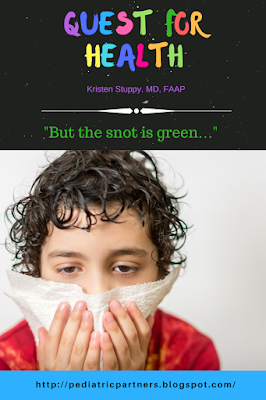
"But the snot is green…" Or "How can we treat cough and colds?"

This time of year it seems everyone is at least sniffling. Many have annoying coughs. Coughs are annoying to others who wonder why that cougher isn't staying at home keeping his germs to himself. They are annoying to the cougher who is up all night coughing (and his parent who also hears it all night long.)
cough, cold, uri, upper respiratory infection, mucus, green mucus, sinus


And then there's all the mucus. We normally make about a liter of mucus a day. Yes, a liter of the stuff. On a good day. It helps moisturize our airway and collects the dust and germs that enter our body. It has antibodies that help fight off the germs it catches. We swallow most of what is made, but when we're sick we make even more. When we're sick it plugs up our noses and makes our head hurt. It drains down the back of our throat, causing us to cough. In kids it drips down the face. It changes color from clear to yellow to green. Sometimes it even gets bloody. It can be thin or thick and sticky. Don't be fooled that the color or thickness means it is for sure "just allergies" because it's clear, or a sinus infection because it's green. These change based on how long it's been in the sinuses, how dry the air is, and other factors. Yellow or green color does not come from bacteria or guarantee that antibiotics will help get rid of the mucus.

Colds and coughs seem to continue forever. Especially since kids get recurrent viral infections this time of year, and they each run into the next illness. I often joke that it doesn't matter if kids get sick in October or January, it will go away by April. Bad joke, but it often seems that once kids start getting sick for the season, they stay sick most days until April.

Here's a graph from way back in 1967 that shows the timeline of a typical upper respiratory illness in an adult:


Remember that kids tend to stay sick longer (and are contagious longer) than adults, so if 20% of adults are still coughing on day 14, you can bet at least that many kids still are coughing with a cold or the flu.


So what can you do to help make kids feel better? As I always say: water, water water.

Water in the air helps thin the mucus, so increase the humidity in the bedroom during the dry winter months. Use a humidifier or vaporizer in the bedroom during illnesses even if your home has a humidifier attached to the heater. Humidifiers with a cool mist are safest with young children. Be sure to follow package directions for cleaning and changing the filter. Vaporizers are generally less work to use, but the steam comes out very hot and can burn young children. Again, follow package directions for proper cleaning and use. Allow it to dry out a bit during the day to avoid build up of mold. 
Water in the nose in the form of saline can really help. The salt in the saline draws the fluid out of the swollen nasal passageways, decreasing the swelling and opening the airway to allow more mucus to be blown (or sucked) out.
Increase fluids that kids drink. Really push water. And unless a child is allergic to milk, it is an old wive's tale that milk will make the mucus worse. If that's what they want, they can have milk with a cold. 
I think what really needs to happen is to get the mucus out. Using saline along with a strong blowing (or suctioning) of the nose is important.

For infants and younger children it can be hard to blow forcefully to get the mucus out. I have been disappointed in the use of a bulb suction because it is very difficult to make a seal and to have enough air to really get a good suction. They tend to cause trauma to the nose because you need to stick it up so high to make a seal. I like nasal aspirators that seal outside the nose and have a continuous flow of air. Check out How to use the Nosefrida. A similar nasal cleaner is available from Nasopure. (Note: I am not tied to either of these companies and do not get any payment from either company.)
For kids over 2 years old, washing the nose is one of the best ways to treat (and prevent) nasal congestion. Check out this video from Nasopure for an easy how to use. (Note: I do not get payment from this company, I simply love the Nasopure company. Not only does the product work well, it is also an all American company. Bottles are made in Kansas City and assembled by disabled adults in Columbia, Missouri.)

What medicines work?

If you choose to use medicines, pick one that has a single active ingredient. Many cold and flu medicines include several active ingredients to treat different symptoms. This increases the likelihood you will use a medicine that isn't needed (because you don't have that symptom) as well as increases the risks of side effects. Also if there is an allergic reaction, you won't know which component was the culprit.

I don't recommend decongestants most of the time. They can make the mucus more thick, which plugs the nose more. If a child is old enough to say if it helps or not (generally over 6 years) and it helps, then it is okay to use a decongestant for a short term. Side effects are trouble sleeping, shakiness, nervousness, increased blood pressure and increased heart rate.

Antihistamines block the histamine that is triggered from allergies. It helps decrease the amount of mucus made when allergies flare, but don't help with the typical cold. Side effects are drowsiness, impaired coordination, excitability in children, and dry mouth.

Guaifenesin is supposed to help thin out mucus to help cough it up. Some studies say it works, others disagree. Again, if a child is old enough to say it helps and it does, use it. Otherwise don't. Side effects can include dizziness, drowsiness, confusion, blurry vision, or lightheadedness.

Studies do not show that any cough suppressant works very well. Honey has actually been shown to help better. Use honey only in kids over 1 year of age due to risks of botulism.

For influenza many people request Tamiflu. Here's my blog on Tamiflu describing why I will be forced to use a medicine I don't like. (It's too long to explain here.)

Another blog going in depth on cough medicines is Cough Medicine: Which one's best?

Tuesday, April 30, 2013

Allergy Tips

photo source: Shutterstock
It's allergy season! Prevention and treatment is important if you have seasonal allergies so you can enjoy the great outdoors.

Symptoms of Allergies: 

Allergies can impair sleep (leading to all the problems associated with not enough sleep) and can lead to the annoying symptoms of itching, coughing, sneezing, runny nose, and watery eyes. Some kids get a crease across their nose from wiping. Others get purple circles under their eyes called allergic shiners. These symptoms last longer than the typical cold, which usually resolves after 1-3 weeks. Fever is a sign of infection, not allergies. Other than fever, it is very difficult sometimes to decide if it is a virus or allergies until a seasonal pattern really develops. Even then it is possible to get colds during allergy season some years!

Treatments: 

It is best to treat before the symptoms get bad. I registered on (and recommend) Pollen.com for free alerts at the beginning of the season to anticipate the need to treat before symptoms begin. Treatments include medicines and limiting exposure.

Medications:

I don't want kids with outdoor allergies to be afraid to go outside, so taking medicines to keep the symptoms at bay while out can help. Types of medicines:
  • Antihistamines work to block histamine in the body. Histamine causes the symptoms of allergies, so an antihistamine can help stop the symptoms. Some people respond well to one antihistamine but not others. In general I prefer the 24 hour antihistamines simply because it is impossible to cover the full day with a medicine that only lasts 4-6 hours. Different antihistamines work better for some than others. Personally loratadine does nothing for me, fexofenadine is okay, but cetirizine is best. I have seen many patients with opposite benefits. You will have to do a trial period of a medicine to see which works best. If they make your child sleepy, giving at bedtime instead of the morning might help. Prescription antihistamines are available, but usually an over the counter type works just as well and is less expensive. 
  • Antihistamine and decongestant combinations are available but are not usually recommended by me. Once control of the mucus is achieved, a decongestant isn't needed. 
  • Nasal spray antihistamines are available over the counter and as a prescription. An office visit to discuss the value of these for your child and proper use is recommended. 
  • Eye drops can help alleviate eye symptoms. They are available both as over the counter allergy drops and prescription allergy eye drops. If over the counter drops fail, make an appointment to discuss if a prescription might help better. Tips to administer eye drops include washing hands before using eye drops, put the drop on the corner of the closed eye (nose side) and then have the child open his eyes to allow the drop to enter the eye. 
  • Singulair (Montelukast) works to stop histamine from being released into the body. It helps control both allergies and asthma and is best taken in the evening. It is available only by prescription, so make an appointment to discuss this if your child might benefit.
  • Steroids decrease allergic inflammation well. These can include both oral steroids for severe reactions (such as poison ivy on the face or an asthma attack) and inhaled corticosteroids for the nose (or lungs in asthma). These require a prescription, so a visit to your provider is recommended to discuss proper use.

Limiting Exposure:  The longer your airway is exposed to the allergen (pollen, grass, mold, etc) the more inflammation you will have.

  • Wash hair, eyelashes, and nose after exposures -- especially before sleep. They all trap allergens and increase the time your body reacts to them. I have found the information and videos on Nasopure.com very helpful to teach kids as young as 2 years to wash their noses. (Note: I have no financial ties to Nasopure... I just love the product and website!)
  • Remove clothing and shoes that have pollen on them when entering the house to keep pollen off the couch, beds, and carpet.
  • Wash towels and sheets weekly in hot water.  
  • Vacuum and dust weekly. Consider cleaning home vents. Consider hard flooring in bedrooms instead of carpeting. 
  • Wash stuffed animals and other toys regularly and discourage allergic children from sleeping with them. 
  • There are many types of air filters that have varying benefits and costs. For information on air filters see this pdf from the Environmental Protection Agency: Aircleaners. 
  • Keep the windows closed. Sorry to those who love the "fresh air" in the house. For those who suffer from allergies, this is just too much exposure!  
  • Keep pets out of bedrooms. If you know a family member is allergic to an animal, don't get a new pet of this type! If you already have a loved pet someone in the home is allergic to, consider allergy shots against this type of animal. 
  • If itchy eyes are a problem for contact lens wearers, a break from the contacts may help. Talk with your eye doctor if eye symptoms cause problems with your contacts. 
What if all of the above isn't helping?
  • Maybe it's really not allergies. 
  • Allergies to things other than foods are rare before 2 years of age.
  • Viruses can cause very similar symptoms to allergies. 
  • Allergy testing is possible by blood or skin prick testing, but can be costly. In most cases I don't find it very helpful for environmental allergens because you can't avoid them entirely and you can always limit exposures as above. I think that tracking seasonal patterns over a few years can identify many of the allergens. You can still treat as needed during this time. Reports of pollen and mold counts are found on Pollen.com. Note also animal exposures and household conditions. Write symptoms and exposures weekly (or daily). It often doesn't take long to see patterns. Testing is important if allergy shots are being considered.   
  • Need help tracking allergy symptoms? There's an app for that! Here's one review I found of allergy apps. I don't have any personal experience of any, so please put your favorite in the comments below to help others!
  • Wrong medicine or wrong dose. 
  • Some people have more severe allergies and need more than one treatment. Allergies tend to worsen as kids get older. Switching types of medication or adding another type of medicine might help. If you need help deciding which medicine(s) are best for your child, an office visit for an exam and discussion of symptoms is advised.
  • Some kids outgrow a dose and simply need a higher dose of medicine as they grow. 
  • Consider allergy shots (immunotherapy) to desensitize against allergens if symptoms persist despite your best efforts as above. Schedule an appointment to discuss if this is an option for your allergy sufferer.